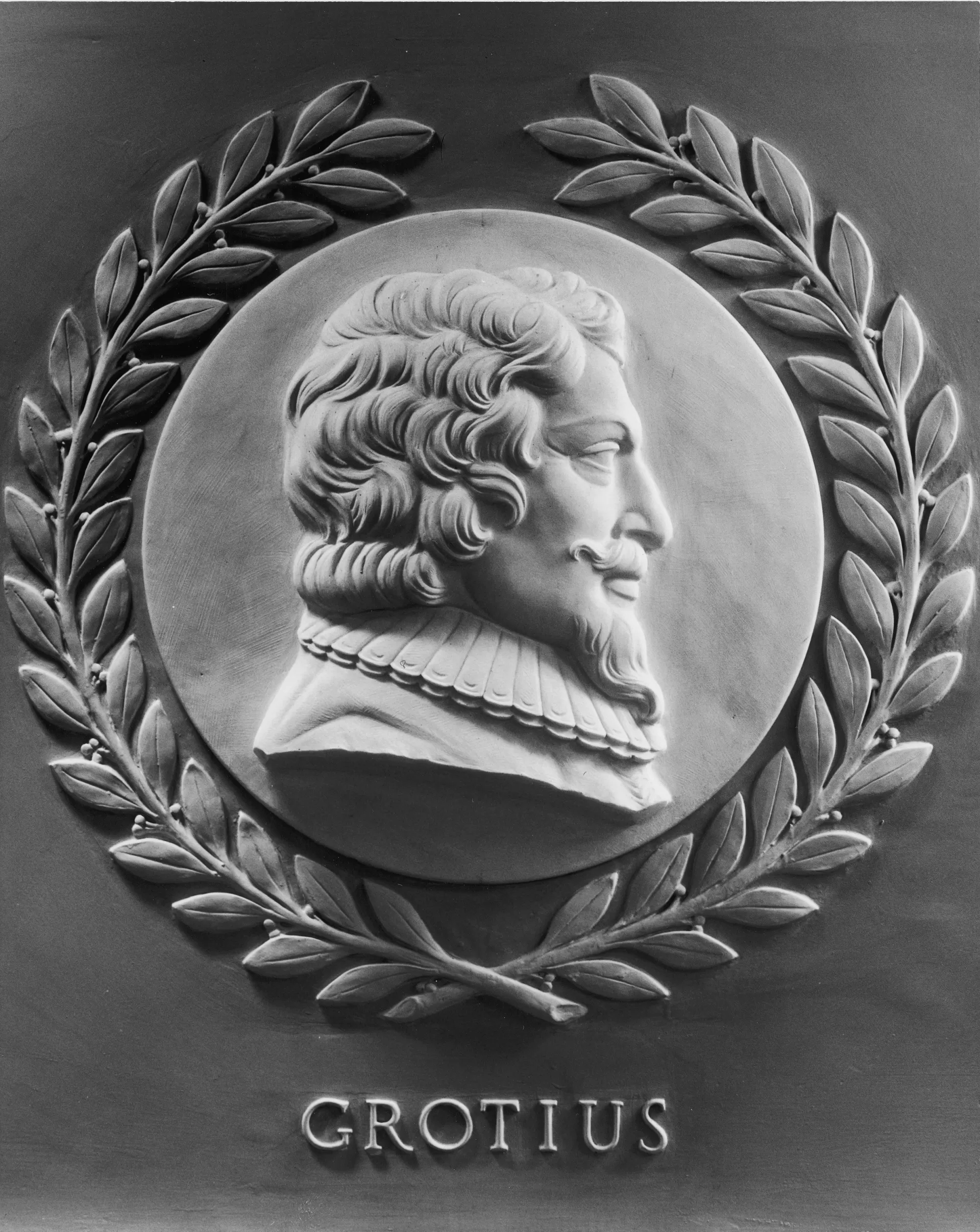
U.S. House of Representatives chamber
Hugo Grotius did not write a law code or preside over a legislature, but he did something arguably more consequential: he invented the conceptual framework within which nations can have legal obligations to one another. Before Grotius, the conduct of states in war and peace was governed primarily by custom, religious teaching, and raw power. After him, it was possible to speak of international law as a genuine legal system binding on sovereign states — a transformation whose effects are still unfolding.
His greatest work, De Jure Belli ac Pacis ("On the Law of War and Peace," 1625), composed during his exile in Paris after a dramatic escape from prison in a book chest, systematically organized the principles governing the conduct of war and the terms of peace. Grotius argued from natural law: he held that certain moral principles are discoverable by reason and binding on all human beings and all nations, whether or not those principles are backed by divine sanction or positive law. This was a startling move. He famously wrote that his principles would hold "even if we were to grant, what we cannot grant without the utmost wickedness, that there is no God." Natural law, in his hands, became a secular and rational foundation for international obligation.
De Jure Belli ac Pacis addressed the justice of going to war (jus ad bellum) — which he grounded in self-defense, injury reparation, and punishment — and the rules governing how war must be conducted (jus in bello). Grotius argued that even in war, combatants had obligations to civilians, prisoners, and neutrals, and that certain acts were prohibited regardless of military necessity. These principles fed directly into the modern laws of war and eventually into the Geneva Conventions.
An earlier work, Mare Liberum ("The Free Sea," 1609), argued that the ocean is international territory that cannot be claimed by any sovereign power — a doctrine of the freedom of the seas that shaped international maritime law and directly challenged the Spanish and Portuguese claims to monopolize oceanic trade routes. The tract was commissioned by the Dutch East India Company but its legal argument became universal.
Grotius also shifted the philosophical understanding of rights. He moved legal theory away from rights as object-based concepts (a right to a thing) toward person-centered ones (a right as a faculty or capacity belonging to a person) — a conceptual shift that laid the groundwork for Enlightenment natural rights theory as developed by Locke, Pufendorf, and ultimately the American founders.
- Mare Liberum ("The Free Sea," 1609) — Argued that the sea is open to all nations and cannot be claimed as national territory; foundational text of international maritime law.
- De Jure Belli ac Pacis ("On the Law of War and Peace," 1625) — Three-book treatise on the law of nations, just war theory, and the natural law foundation of international obligation. The founding text of modern international law.
- De Jure Praedae ("On the Law of Prize and Booty," written c. 1604, published 1868) — Earlier work on the legality of privateering; Mare Liberum was a chapter extracted from it.
- Introduction to Dutch Jurisprudence (Inleidinge tot de Hollandsche Rechtsgeleerdheid, 1631) — Systematic treatment of Roman-Dutch law; highly influential in South Africa and other Dutch colonial legal systems.
Grotius represents the natural law and law of nations tradition — the strand of legal thought that sits between the Roman civil law tradition and the modern law of international relations. He stands at the pivot point between medieval scholastic just war theory (Aquinas, Vitoria) and Enlightenment political philosophy (Locke, Rousseau, Kant). His influence on the American founding generation was profound: the Declaration of Independence's appeal to "the Laws of Nature and of Nature's God" and to the "opinion of mankind" is Grotian in its framework, and the architects of American foreign policy through the early Republic explicitly invoked his principles. Among the House lawgivers, he is the key figure of the early modern period bridging medieval jurisprudence and the constitutional theory of the 18th century.
- Wikipedia: https://en.wikipedia.org/wiki/Hugo_Grotius