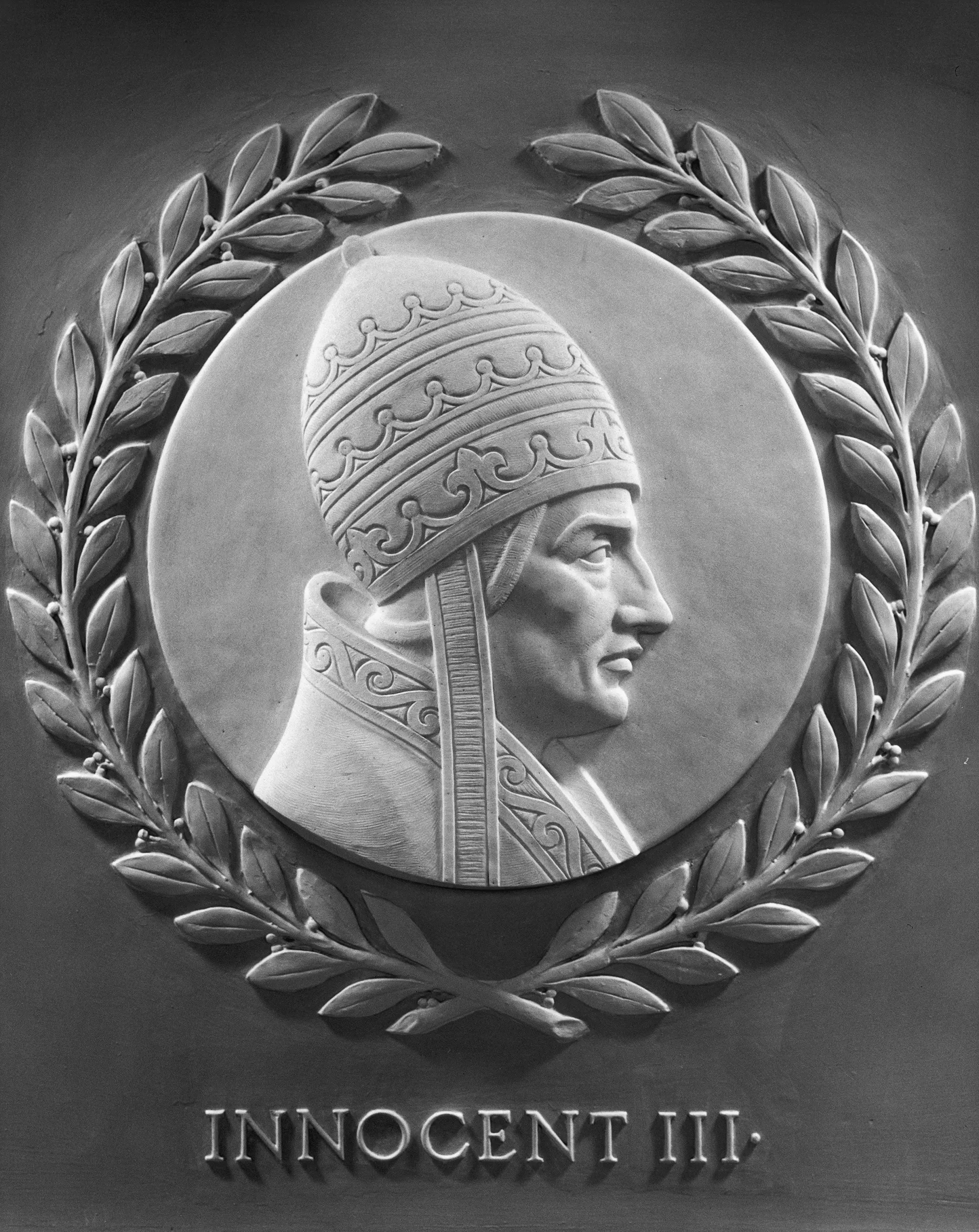
U.S. House of Representatives chamber
Innocent III presided over the high-water mark of papal legal power in the Middle Ages. A trained lawyer educated at Bologna and Paris, he brought exceptional legal intelligence to the papacy and used it to extend canon law into nearly every domain of European governance — marriage, inheritance, oaths, heresy, and the relations between secular rulers and their subjects. His papacy was, among other things, the greatest single expansion of canon law since Gratian's Decretum had systematized it in the 1140s.
His most enduring legal achievement was convening the Fourth Lateran Council in November 1215, the largest ecclesiastical gathering of the medieval period and a legislative event of enormous consequence. The Council issued seventy reformatory decrees touching the full range of Church governance. Canon 18 prohibited clergy from participating in trials by ordeal — a ruling that effectively killed the institution throughout Europe, since ordeals required a priest to bless the fire or water. Without clerical participation they lost their rationale. This single decree transformed criminal procedure across the continent, forcing courts to develop evidence-based fact-finding in its place. The result, over the following century, was the elaboration of the inquisitorial procedure that became the basis of Continental criminal law.
Other landmark decrees of the Fourth Lateran Council required annual confession and communion from all Christians (establishing a sacramental legal framework), set detailed procedures for episcopal elections, prohibited new religious orders without papal approval, and mandated that Jews and Muslims wear distinctive clothing — provisions that had profound and often tragic legal consequences for minority communities across medieval Europe.
Beyond the Council, Innocent was extraordinarily prolific as a legislator through his decretal letters. He issued thousands of papal letters that addressed legal questions brought to him from across Europe, and these letters — which represented binding interpretations of canon law — were collected and organized into compilations that fed into Gregory IX's later Liber Extra of 1234. Innocent also asserted, more forcefully than any previous pope, that the papacy held the right to examine and approve candidates for the imperial throne, using excommunication and interdict as instruments to enforce this claim against the Holy Roman Emperor.
- Canons of the Fourth Lateran Council (1215) — Seventy legislative decrees covering confession, episcopal elections, heresy proceedings, Jews and Muslims, and the conduct of clergy. The most influential single ecclesiastical legislative act of the medieval period.
- Decretal letters (1198–1216) — Thousands of papal letters addressing legal questions from across Europe; incorporated into subsequent canon law compilations.
- Compilatio tertia (1210) — One of the first official papal collections of decretals, sent to the University of Bologna as authoritative law.
Innocent III and Gregory IX are the two popes among the House lawgivers, and they represent consecutive stages of the same great project: the legal consolidation of the medieval Catholic Church. Where Innocent was the legislator — convening councils, issuing decretals, asserting jurisdiction — Gregory was the codifier, organizing the legal legacy of Innocent and his predecessors into the systematic Liber Extra. Together they made canon law the most advanced and comprehensive legal system in medieval Europe, one that governed the personal lives of virtually every person on the continent and whose procedural innovations — including the development of evidence-based trial procedure — fed directly into the secular law systems that eventually became the common law and civil law traditions.